The Problem with "Full Automation"
When you deploy your first AI agent to production, the excitement is real: it works in demos, passes your test cases, and handles sample data flawlessly. Then one day, the agent automatically sends refund emails to 10,000 customers — because it interpreted your "refund policy" more literally than you ever intended.
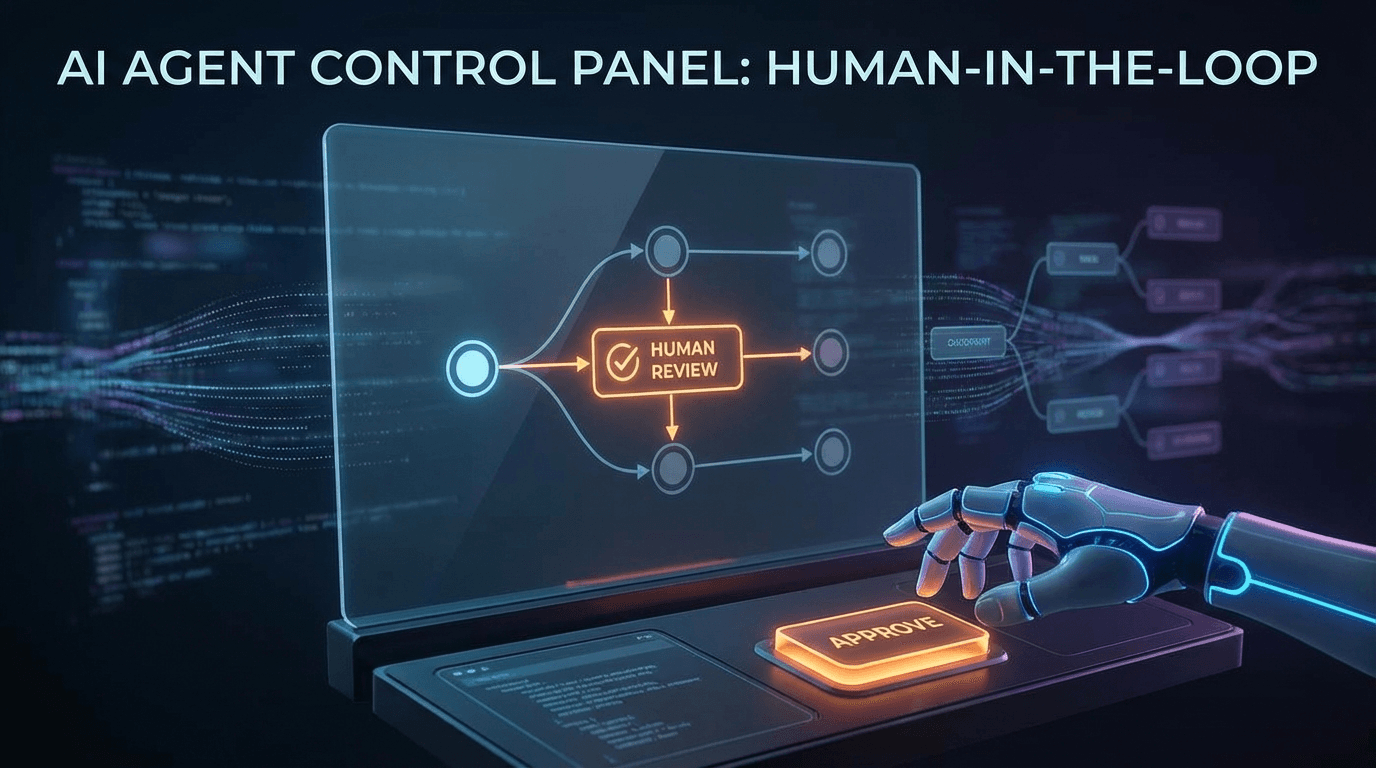
Autonomous ≠ Trustworthy. This is the core principle of Human-in-the-Loop (HITL): humans aren't an obstacle to automation — they're the smartest safety layer you have.
The question isn't "should I use HITL?" but "where and when should I apply it?"
If you're building complex agent systems, also read our guide on Multi-Agent Systems: When You Need More Than One AI for context on how HITL fits into larger architectures.
Risk Matrix: Classify Tasks Before Automating
Before deciding whether an agent should "run freely" or needs a checkpoint, evaluate each task along two axes:
- Risk: What's the consequence if the agent gets it wrong?
- Reversibility: Can the action be undone?
| Easily Reversible | Hard to Reverse |
|---|
| Low Risk | ✅ Full automation | ⚠️ Auto + logging |
| High Risk | ⚠️ Auto + alert | 🛑 HITL required |
Real-world examples:
| Task | Risk | Reversible | Decision |
|---|
| Classify support ticket | Low | Yes | ✅ Full auto |
| Draft marketing email | Medium | Yes | ⚠️ Auto + review |
| Send user notification | High | No | ⚠️ Approval gate |
| Cancel order | High | Partial | ⚠️ Auto + alert |
| Delete user data | Very high | No | 🛑 HITL required |
| Transfer funds | Very high | No | 🛑 HITL required |
3 HITL Patterns in Practice
Pattern 1: Approval Gate
The agent stops and waits for human approval before executing any high-risk action.
Agent processes → 🔴 Checkpoint → Human reviews → Continue / Reject
When to use: Financial tasks, sending data outside the system, deleting or modifying critical records.
const graph = workflow.compile({
checkpointer: new MemorySaver(),
interrupt_before: ["execute_action"],
})
await graph.invoke(
new Command({ resume: { approved: true, note: "Looks good" } }),
{ configurable: { thread_id: "task-123" } }
)
Pros: Maximum safety for non-reversible tasks.
Cons: Creates a bottleneck — requires a human to be available.
Pattern 2: Async Override
The agent executes immediately but sends a notification to a human. Within a defined window (override window), the human can intervene and veto.
Agent processes → Execute → 📩 Notify human → [Override window: 10 min] → Complete
                                              ↑
                              Human can override within this window
When to use: Sending internal emails, creating content drafts, updating non-critical configurations, triggering downstream workflows.
async function executeWithAsyncOverride(action: AgentAction) {
const result = await executeAction(action)
await overrideQueue.push({
actionId: action.id,
result,
expiresAt: Date.now() + 10 * 60 * 1000,
})
await notify.send({
channel: "agent-actions",
message: `Agent just executed: ${action.description}`,
actions: [{ label: "Undo", url: `/override/${action.id}` }],
})
return result
}
Pros: Doesn't slow down the workflow while maintaining a safety net.
Cons: Humans must respond quickly within the override window.
Pattern 3: Shadow Mode
The agent runs in parallel with the existing manual process. Agent output is logged and compared but not yet applied.
Human process ──────────────────────────────→ Real output
Agent process  → [Shadow] → Log & Compare   → (Validation only, not deployed)
When to use: The validation phase when first deploying an agent. You build trust gradually before fully handing over control.
Metrics to track in Shadow Mode:
- Agreement rate with human decisions (target: >95%)
- False positive / false negative rate
- Edge cases the agent encounters but doesn't handle correctly
Implementing HITL with LangGraph
LangGraph is the ideal framework for HITL because it has interrupt built in as a first-class concept:
from langgraph.graph import StateGraph
from langgraph.checkpoint.memory import MemorySaver
from langgraph.types import Command, interrupt
def human_approval_node(state: AgentState):
decision = interrupt({
"question": "Approve action?",
"action": state["pending_action"],
"context": state["reasoning"],
})
if not decision["approved"]:
return {"status": "rejected", "reason": decision.get("note")}
return {"status": "approved"}
graph = (
StateGraph(AgentState)
.add_node("analyze", analyze_node)
.add_node("human_approval", human_approval_node)
.add_node("execute", execute_node)
.add_edge("analyze", "human_approval")
.add_conditional_edges(
"human_approval",
lambda s: s["status"],
{"approved": "execute", "rejected": END},
)
.compile(checkpointer=MemorySaver())
)
With Anthropic tool use, classify tools explicitly as "safe" vs. "requires_approval":
const SAFE_TOOLS = ["search_web", "read_file", "calculate", "summarize"]
const APPROVAL_REQUIRED = ["send_email", "delete_record", "create_payment", "update_config"]

async function executeWithHITL(toolCall: ToolCall): Promise<ToolResult> {
  if (APPROVAL_REQUIRED.includes(toolCall.name)) {
    const { approved, note } = await requestHumanApproval({
      tool: toolCall.name,
      input: toolCall.input,
      agentReasoning: toolCall.reasoning,
    })

    if (!approved) {
      return { error: `Action rejected: ${note}` }
    }
  }

  return executeTool(toolCall)
}
For more on tool-based agent architecture, see AI Agent Tool Use: How MCP Connects AI to Your Business.
Scaling Autonomy Over Time
HITL isn't a fixed state. Design your agent to automatically increase autonomy as it builds a track record:
Weeks 1–2:  Shadow Mode    → Log only, no real actions
Weeks 3–4:  Approval Gate  → Every action needs approval
Month 2:    Async Override  → Self-executes, human has 10 min to veto
Month 3+:   Full Auto       → Alert only on anomaly or low confidence
Metrics to decide when to "level up" autonomy:
- Accuracy > 95% across at least 100 real cases
- Zero critical errors in 2 consecutive weeks
- Human override rate < 5%
- P99 latency of human review > 30 minutes (meaning human review has become the bottleneck)
This escalating autonomy model pairs naturally with giving your agent persistent memory — the more context an agent retains, the more reliably it handles edge cases without human intervention.
Logging and Observability Are Non-Negotiable
Regardless of autonomy level, you always need:
- Audit log of every agent action — who, what, when, outcome
- Confidence score — agents should self-report when uncertain
- Escalation path — when confidence is low, automatically switch to HITL
- Real-time dashboard — human observers can monitor at any time
async function agentDecide(context: TaskContext): Promise<Action> {
const { action, confidence, reasoning } = await llm.decide(context)
await auditLog.write({ action, confidence, reasoning, timestamp: new Date() })
if (confidence < 0.80) {
await escalateToHuman({
task: context.task,
suggestedAction: action,
confidence,
reasoning,
urgency: confidence < 0.60 ? "high" : "normal",
})
return { type: "pending_human_review" }
}
return action
}
Conclusion
Human-in-the-Loop isn't an admission that AI isn't good enough yet. It's intelligent system design — understanding the strengths and weaknesses of each component, then assigning the right tasks to the right actor.
Key principles:
- Start with more HITL, reduce gradually based on real data — never start with full automation
- Never fully automate non-reversible tasks without a safety net
- Log first, automate later — you need data to build trust
- Design for failure — when the agent makes a mistake, humans must catch it immediately, not three days later
The best agent isn't the fastest one — it's the agent you can confidently deploy to a real product without losing sleep at night.