What Is MCP?
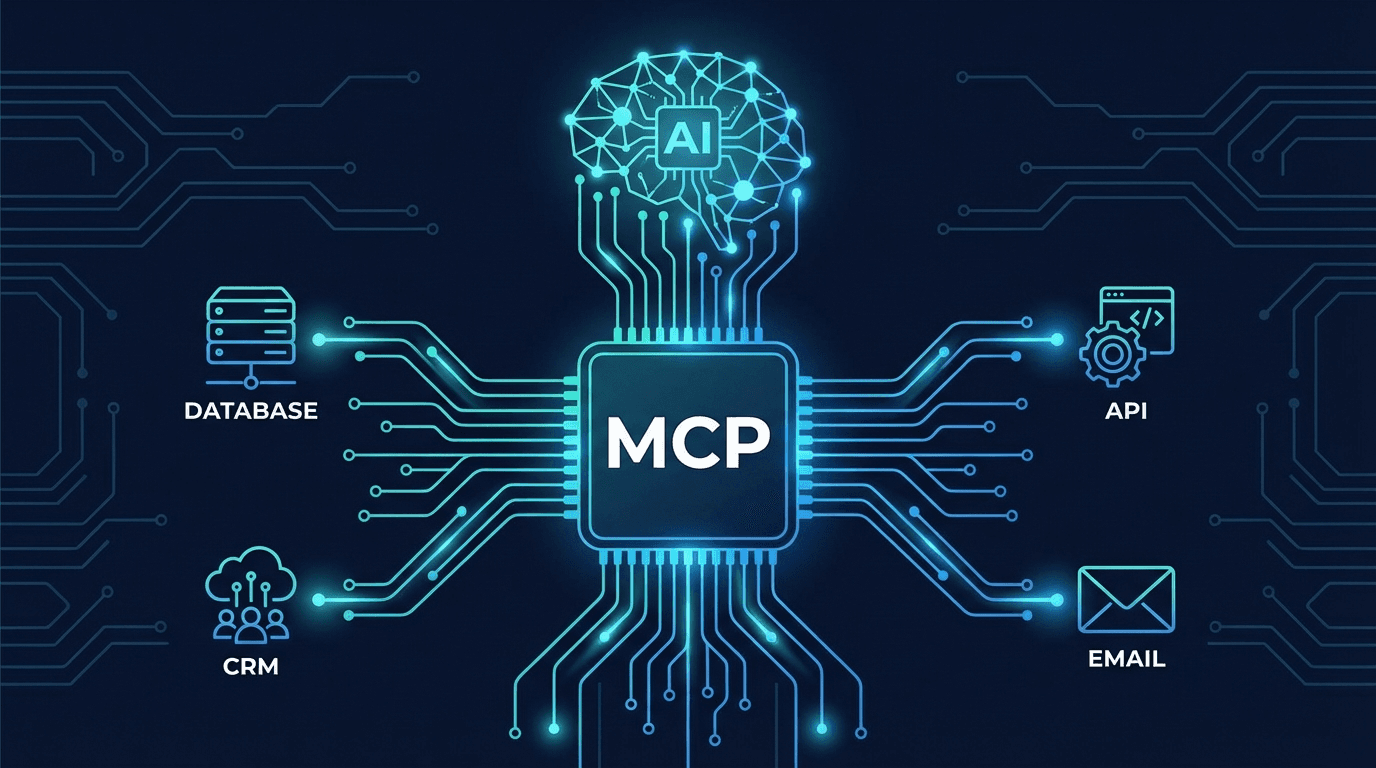
Model Context Protocol (MCP) is an open standard created by Anthropic that gives AI models a universal way to interact with external tools and data sources — without custom adapters for every integration.
Think of MCP as the USB-C of AI integrations: one standard port that works with any device. Whether you're connecting Claude, GPT-4, or Gemini to your CRM, database, or internal APIs, MCP handles the communication layer for you.
See how AI Agent Tool Use with MCP brings this to life in real business workflows.
Why MCP Matters
Before MCP, building AI integrations was painful:
| Without MCP | With MCP |
|---|
| Custom adapter per AI provider | One protocol, all providers |
| Duplicated auth logic | OAuth 2.0 built-in |
| Tool schemas diverge over time | Unified JSON-RPC schema |
| No discovery mechanism | Server capability negotiation |
If you swapped from Claude to GPT-4, you'd rewrite every integration. MCP eliminates that.
Architecture
AI Model ←→ MCP Client ←→ MCP Server ←→ Your Tools / Data
MCP Client
Lives in your AI application. Discovers what tools the server exposes, then routes tool calls on behalf of the AI model.
MCP Server
A lightweight service you deploy. It wraps your existing APIs, databases, and functions into MCP-compatible tool definitions.
MCP Server Components
- Tools — callable functions the AI can invoke (e.g.,
search_crm, send_email, query_database)
- Resources — data the AI can read (e.g., documents, rows, files)
- Prompts — pre-built prompt templates for common tasks
Transport Options
MCP uses JSON-RPC 2.0 and supports two transport modes:
SSE (Server-Sent Events)
Best for streaming responses and long-running tool calls. The server pushes events to the client as they happen.
HTTP
Simple request/response. Ideal for tools that return a single result quickly.
Most production deployments use SSE for a real-time feel.
Authentication & Security
MCP implements OAuth 2.0 with PKCE flow:
- Your AI client requests authorization from the MCP server
- User (or system) approves via OAuth consent screen
- Server issues a short-lived token stored in KV (e.g., Cloudflare KV, Redis)
- Every subsequent tool call includes the Bearer token
- Token rotation happens automatically
This means your internal tools are never directly exposed to the AI model — only the MCP server boundary is.
Related: Human-in-the-Loop AI — when should your MCP server require explicit human approval before executing a tool call?
Building an MCP Server
Here's a minimal MCP server in TypeScript:
import { MCPServer } from "@anthropic/mcp";

const server = new MCPServer({
  name: "my-business-tools",
  version: "1.0.0",
});

server.addTool({
  name: "search_customers",
  description: "Search CRM for customer records",
  inputSchema: {
    type: "object",
    properties: {
      query: { type: "string" },
    },
    required: ["query"],
  },
  handler: async ({ query }) => {
    return await crm.search(query);
  },
});

server.start();
The AI never sees your CRM code — it only sees the tool description and gets back the result.
Example: Autonow MCP Server
Our MCP server at mcp.autonow.com exposes:
search_articles — Search our knowledge base by topicget_article — Fetch full article content by slugget_mvp_info — Service descriptions and pricing
Any AI assistant that supports MCP can now answer questions about Autonow's services using live data — not stale training data.
Getting Started: Connect from Claude Desktop
{
  "mcpServers": {
    "autonow": {
      "url": "https://mcp.autonow.com/sse"
    }
  }
}
Add this to ~/Library/Application Support/Claude/claude_desktop_config.json, restart Claude, and your assistant immediately gains access to the Autonow knowledge base.
MCP in the Broader Agent Ecosystem
MCP is one piece of the AI agent stack. Combined with memory systems, multi-step planning, and human-in-the-loop controls, it lets you build agents that can actually do things — not just answer questions.
Explore the full picture in Building AI Agents in 2026.
MCP has already been adopted by Zed, Replit, Codeium, and dozens of other AI tooling companies. If you're building anything with AI in 2026, understanding MCP is no longer optional.